
Shaping Organizational Design for AI in a Human Way
with Franconian Carnival as a role model

There’s a lively debate going on about what an organization needs to look like to adopt AI at scale. So many posts, articles, opinions, comments. And sure, they all make valid points. But I’d like to invite you to stop for a moment and forget all of it.
You know those meetings. Tons of participants, workshops with colorful slides about strategy, half the room asleep or doom scrolling through social media or just quietly working on something else. I’m telling you, people are done with this. They’re annoyed and bored.
In the companies where I was present when large-scale change actually happened with great success – and I’m talking about Global Fortune 500 – something entirely different took place.
Have you ever been in a room or meetings full of people, where suddenly everyone stops what they’re doing. Everyone looks at you. Nobody checks their phone. It’s dead silent. You could hear a pin drop. Because everyone in that room finally feels: Yes… That’s it! And something big is about to happen.
It’s the connection of feeling understood, sensing that there is a practical common sense and at the same time, there is a good story, a vision, a bigger picture, dreams… It’s the moment where you think: now it makes …SENSE!
It’s that exact blend of an inspiring vision and a connection to an origin story where magic happens. This is the starting point. How do create that? And how do you keep the magic going? And how do you make something big out of it?
I’ve seen this happen. I’ve been part of it. What I’m sharing here is one lens, not the only one. There are certainly many ways to explain what makes transformation work. This article offers mine – based on what I’ve observed, rooted in where I grew up.
I was thinking a lot about what the secret sauce is.
I spent some years abroad, and that distance made me think a lot about my own culture. I’m from Franconia, Bavaria, Germany. In this article we only focus on Franconian carinval. It has deep historical roots, but the way it's lived today is remarkably young. A small group of people started it, not long ago. It works from the population up. Thousands of volunteers dedicate their entire free time, year-round, unpaid. They inspire thousands more – and get them to join in.
So let me take you on a journey. I’ll say it bluntly: Don’t restructure your org chart. Don’t launch a project. Don’t do change management. Don’t bring in a consulting firm. Don’t do group therapy. Don’t.
Instead, start very small. A handful of people. And create that magic moment.
At a glance:
Large-scale transformation that begins from a small nucleus that creates something people can recognize, feel, and join, are more likely to be successful.
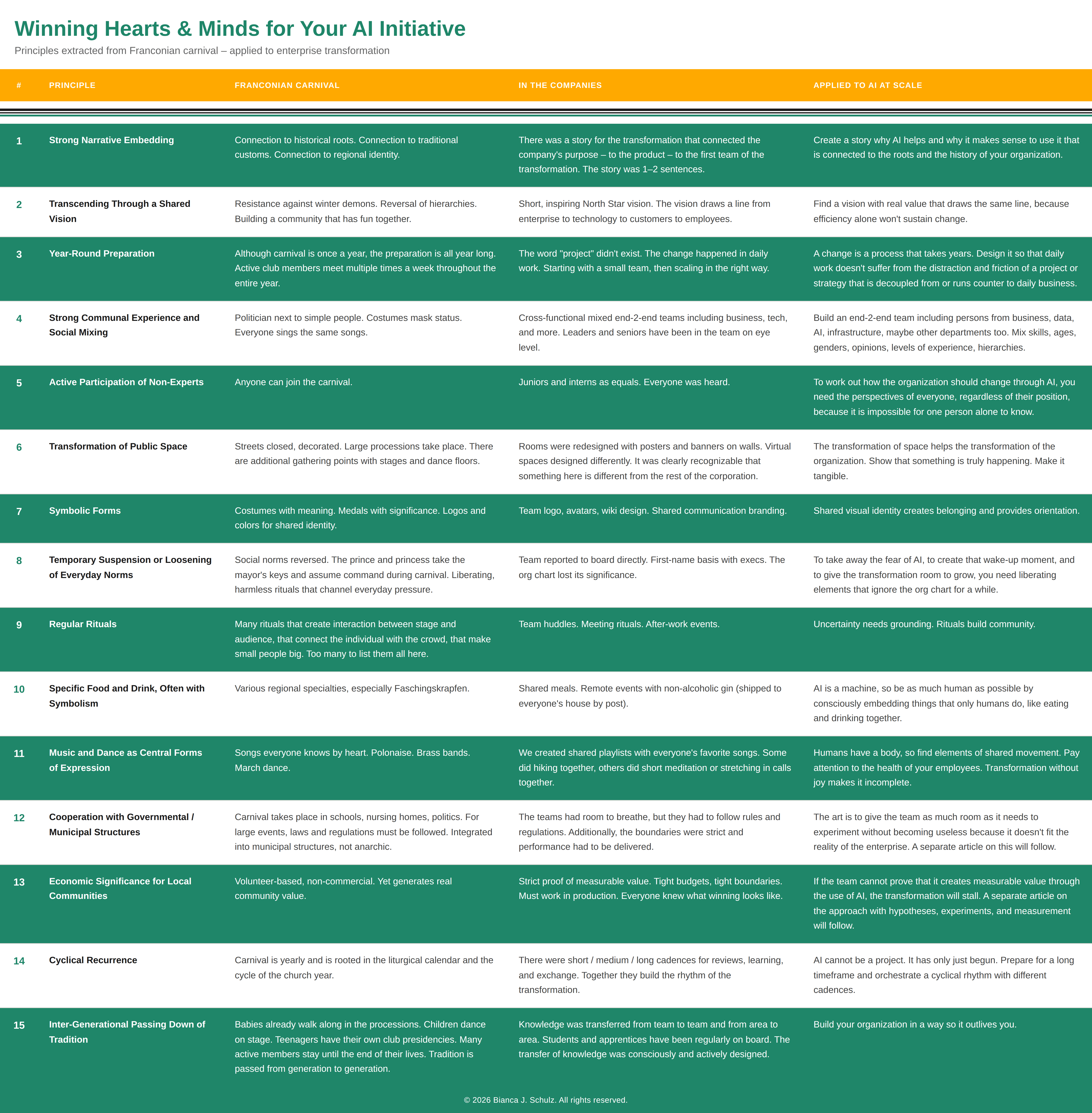
What carries transformation is not a single lever, but a combination of elements, see the table below.
Together, they create the conditions under which people begin to carry the change themselves.
How the first team is set up and what boundaries are put in place is decisive. I'll cover that in a separate article.
Through the work and the outcomes of the team, you learn how the organization needs to change. It happens through experience and learning, not through planning and strategy.
What does that look like in practice? In the companies where I saw this work, the pattern was always the same: A small group of people starts. External advice in small doses. The majority are internal. No frameworks imposed from above – principle-based work instead. That small group needs the magic spark. And from there, they build something new.
The organizational change that was firmly established years later grew out of hands-on experience with a small example that was then scaled up. Not top down. But from a grassroots movement.
Franconian carnival is a good example of how to win hearts and minds. And that's the foundation for AI at scale – because you need many different departments on board. Nobody really knows yet how everything works in detail with AI. The org chart doesn't quite fit anymore, but we do not yet know how exactly it will look like in five years.
Instead of rushing to commit resources in the wrong places, I want to show you principles that help. In the large-scale transformations I was part of, these principles were applied. We didn't talk about carnival back then. But I think a good metaphor helps more than colorful strategy slides.
Here’s what I’ll do: First, the characteristics of Franconian culture, abstracted. Then, a brief look at how these were applied in the companies. And after that, my interpretation.
The characteristics of Francian carnival are these. I extracted them from personal observation, not from a paper or a book. This doesn't claim to be an academic paper. It's simply my personal observation. These may apply certainly to other cultures, too.
Strong narrative embedding
Transcending through a shared vision
Year-round preparation
Cooperation with governmental/municipal structures
Strong communal experience and social mixing
Active participation of non-experts
Transformation of public space
Symbolic forms
Temporary suspension of everyday norms
Regular rituals
Specific food and drink, often with symbolism
Music and dance as central forms of expression
Economic significance for local communities
Cyclical recurrence
Inter-generational passing down of tradition
Here’s an overview of what these elements look like in carnival, how they were lived in the companies, and what I derive from them:
The organization and the org chart will change. But what that will look like in your company – you can’t know yet. And neither can any vendor or strategy consultant.
Only through experience and learning from hands-on implementation will it gradually become clear how you need to change your organization.
Strategies often have the problem that they’re neither rooted in the company’s history nor backed by an inspiring vision. That’s why they lack connection and power.
People want things to make sense. They want to be part of something bigger. AI can only be one piece in that bigger picture.
Let your work be guided by principles. Which principles to apply when setting up the core team – I’ll cover that in the next articles.
In the globally known enterprises where I was part of the transformation, the teams delivered measurable value. Major luxury end-user devices were shipped with new technology. Customer-oriented full automation of processes saved measurable costs. First steps with AI led to sustainably more efficient ways of working with happier employees.
I’ve also been part of large strategy projects where literally millions were burned. I’ve thought long and hard about what makes the difference – because the individuals involved were all highly qualified and wanted nothing but the best.
It’s the way you set up systems.
One thing is already clear: for AI at scale, you don’t just need the data or AI department. You need business, and probably other areas too – legal, HR, others.
If you’re a data or AI lead, the question is: how do you get everyone on board?
Mapped onto my Discipline Net, your organization might be right here. The business value is understood, the end-to-end chain is clear. Now it’s about mobilization – and the orange disciplines are up next:
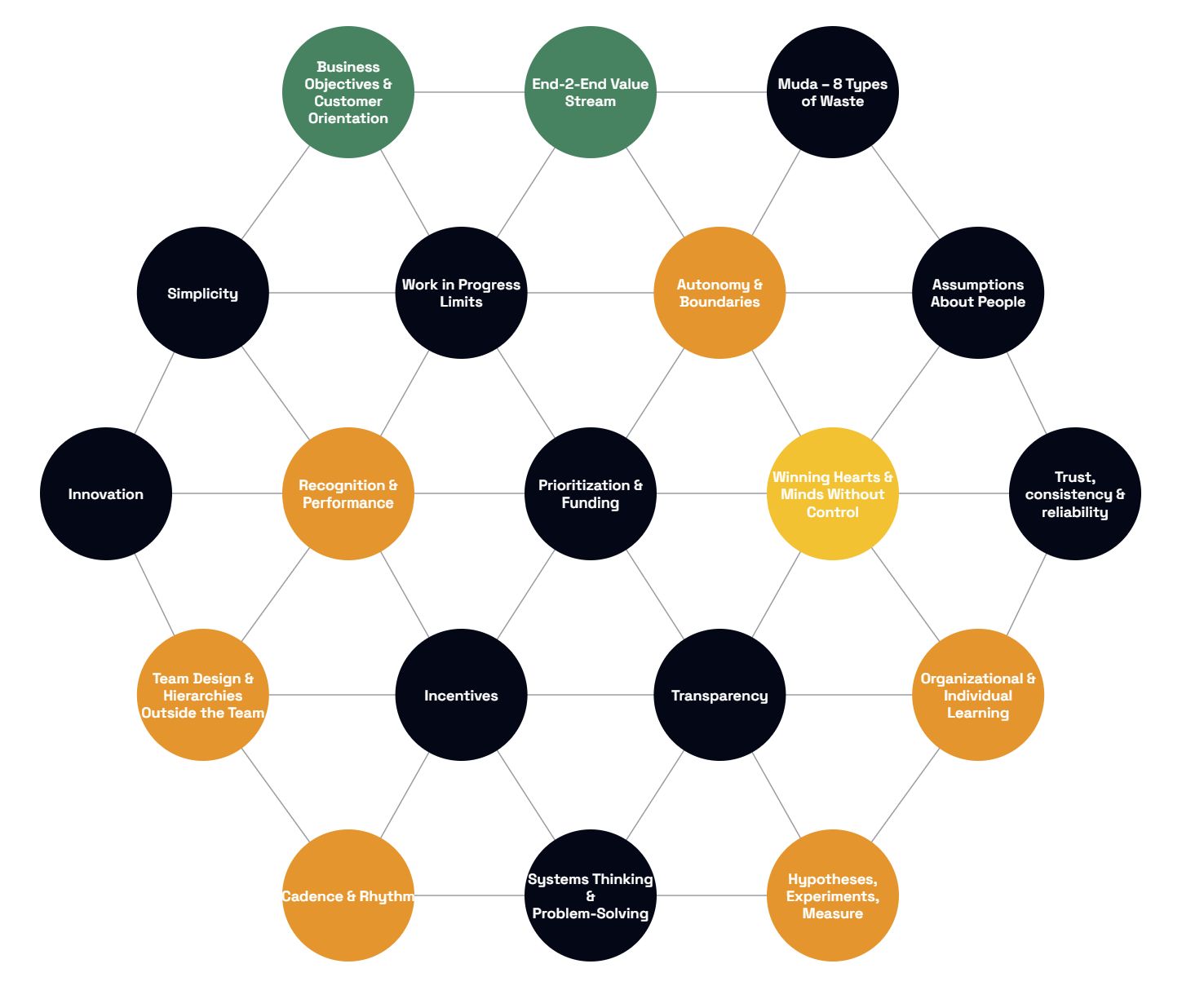
For all of these areas, an awake, motivated core team – that is then scaled the right way – is the best foundation for a successful transformation.
This connects to something i keep noticing - org design conversations often stay at structure level, but the real friction shows up in day-to-day decisions.
who gets to decide, how fast, and with what context.
you can redraw teams on paper, but if those decision paths don’t change, not much really shifts. that’s where most redesigns quietly stall.