
Enable end-2-end teams with different style of leadership and different style of incentives
Learn boundaries and decisions first with humans and then with AI agents

My thesis: Many problems in data/AI teams arise because the organizational system, the teams, the departments, the leaders, the processes etc., is not optimally set up.
In this article I lay out a system that works well in my experience. I have seen it in practice in several organizations. It was very successful and people liked it, it was motivating and also kind of cool. It also works in large enterprises with a lot of complexity and legacy. In one such enterprise I was part of the leadership team (three of us) and we were responsible for seven teams.
Much of what I am about to describe is commonly known. Some of it I developed myself, some of it has been known for years. It is a mix of both. I keep meeting people for whom all of this is new, hence this article.
Think first, then act
In this article I try to present and explain principles. It is important not to copy the ideas and examples one by one.
Every organization is different and every organization has different people. And then there is the market, the customers, the outside world, the available capital, partner companies, unions, affiliated institutions, laws, regulations, there are so many different factors that force you to make trade-offs every day.
Engage with the principles and decide case by case specifically whether and to what extent you can and want to apply them.
If after reading this article you are inspired to implement it, talk openly with your teams about what you want to implement, what you intentionally do differently or not at all. We are all adults. Everyone understands that reality is messy and no one will have a problem with that.
Full transparency
Even if you consciously reject something, everyone will accept it more than if you say nothing about it at all.
I have been able to observe this often in agile transformations. When a leader says, we are doing agile now, and then everything that is agile was rejected and only a piece of Scrum theater was performed, when those leaders kept loudly saying how agile they are, there were three different reactions.
Most people think the leader is stupid. He does not get it. He is too dumb to understand what agile is.
Others think the leader is devious. He claims something externally while internally doing the exact opposite.
And some think: the leader is weak. He wants to be agile but does not dare to implement it properly.
But when the leader says: listen, it is not possible because… and gives reasons, no one has a problem with it.
Gut feeling explicitly welcome!
It is also ok to say that your gut feeling is against it and you cannot explain exactly why. People accept that.
That is mature and wise in my eyes.
What is immature and dangerous is buying some framework including a vendor and rolling it out without having your own opinion.
That is exactly why you are a leader. Because you carry the responsibility and people expect you to deal with difficult situations. Listen to your gut and work with others to figure out where the feeling comes from.
My experience is: when I have a weird feeling, at least two other people in the organization also have a weird feeling.
When I do not understand something, at least one other person does not understand it either.
That is why I am a big fan of leadership teams that discuss exactly these topics.
Fictional example
The fictional chocolate manufactory is developing a new vegan recipe. An AI model evaluates historical recipes, customer feedback and raw material data and suggests ingredient combinations that are promising in terms of taste. A small interdisciplinary team works in short cycles: every week a test batch is produced, tasted and evaluated. An AI agent handles parts of the procurement.
It is intentionally a somewhat far-fetched example. You can imagine what it means, but it is unrealistic enough that you cannot copy it one to one. That is on purpose. You should really think about what your end-2-end team looks like. Here is a guide.
Building an end-2-end team
The team of the chocolate manufacturer consists of Food Product Developer, Production Process Engineer, Machine Operator, Procurement / Raw Material Sourcing, Data Engineer, Machine Learning Engineer, DevOps Engineer, Quality and Regulatory Specialist, Sensory and Consumer Insights Specialist.
It consists of all the skills needed to produce a small sample of the new chocolate recipe and the chocolate itself. If someone from the chocolate industry is reading this and throwing their hands up, it is just an example to illustrate how to make cross-functional teams.
How do you do it in your organization?
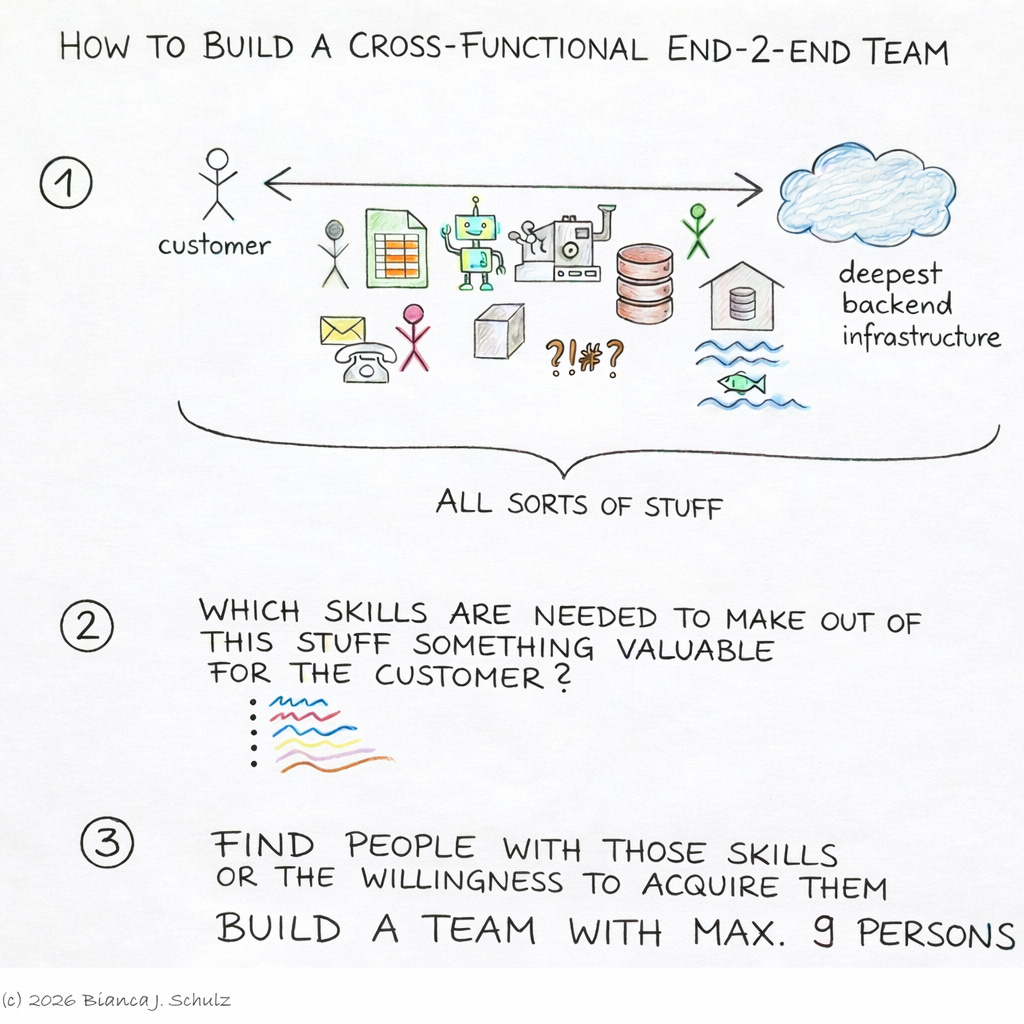
Imagine the customer at one end and the deepest backend infrastructure at the other end. If you work in a large enterprise, there is so much in between that you do not even know what all of it is. Legacy stuff, strange manual processes, a piece of AI somewhere, data, who knows what. You do not have to pull all people from all departments into your team. It is enough to find people who are capable of driving changes in the surrounding systems.
But it has to be the full chain. Why? You need this focus and the view of the whole, because otherwise you will never figure out what you can cut and eliminate. Wherever functional teams are in place, there is always too much of a good thing. It is in the nature of things. Things grow, things expand, and they do so until you limit them. You need a meaningful focus and that is the customer.
If you are a SaaS with extremely many customers, then your end is someone who knows or understands the customer very well. If you are a pharmaceutical company, then your customer might be someone who knows all the sales representatives. If you are a machine manufacturer and your data and AI solution is used for machine maintenance, then your customer might be the machine operator.
You have to figure out who your customer is yourself. But be ambitious. Taking only the business colleague as customer is often too short of a stretch. Who does the business colleague have as a customer? Stretch yourself and be ambitious to make the stretch as long as possible towards the customer, but also be realistic. Start with what you can actually implement soon.
Brief note on central things like central data platforms or central infrastructure elements: there is always a central remainder that has to stay central. So do not be dogmatic. This is more about the principle. Very mature organizations are able to build their central functions in a way that teams can still work autonomously, by encapsulating them well and building them towards a service model. More on this in a later article.
The team must be small so that real and true teamwork emerges. Therefore multiple people in the team must cover multiple skills. Or have the willingness to learn them.
The team contains no managers or other general manager roles. Otherwise there will be too many people and no one should rest on the assumption that the manager will somehow manage it.
Make a colorfully mixed team. Everyone as equals.
Building a Leadership Team
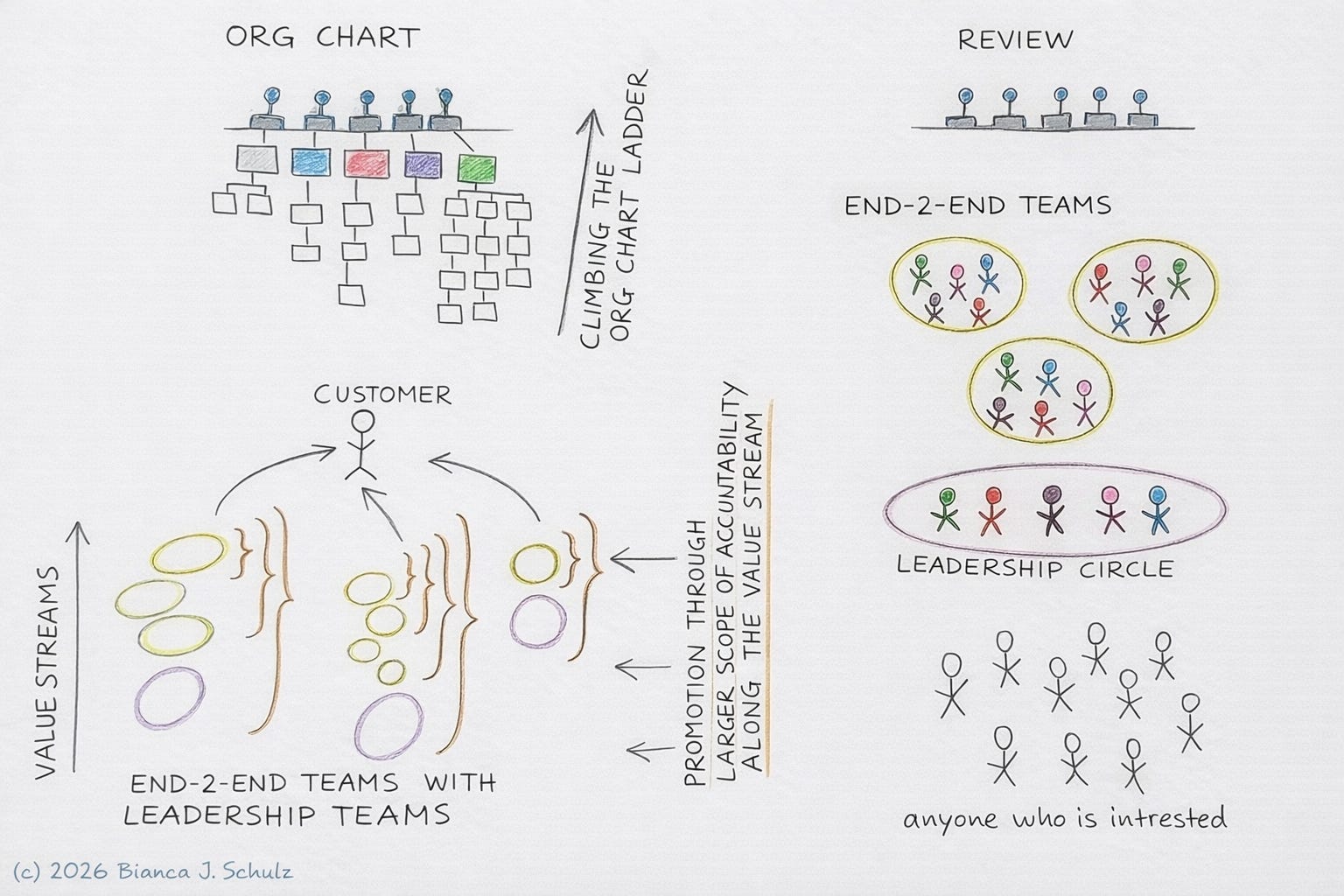
Important: the direct supervisors of the team members must stay out of the teamwork. The team and the team members do not report to their direct supervisors. They report to the board, supported by a leadership team.
What is the leadership team?
Everyone who normally works around teams as a leader in various functions gets redistributed.
The people responsibility, the direct supervisor: this function must become maximally unimportant. This person should eventually in the long run only be responsible for administrative matters. Why? It is about breaking up career paths. Career growth no longer means climbing the org chart. It means taking on more responsibility and accountability along the value stream.
Therefore leadership is split into different dimensions:
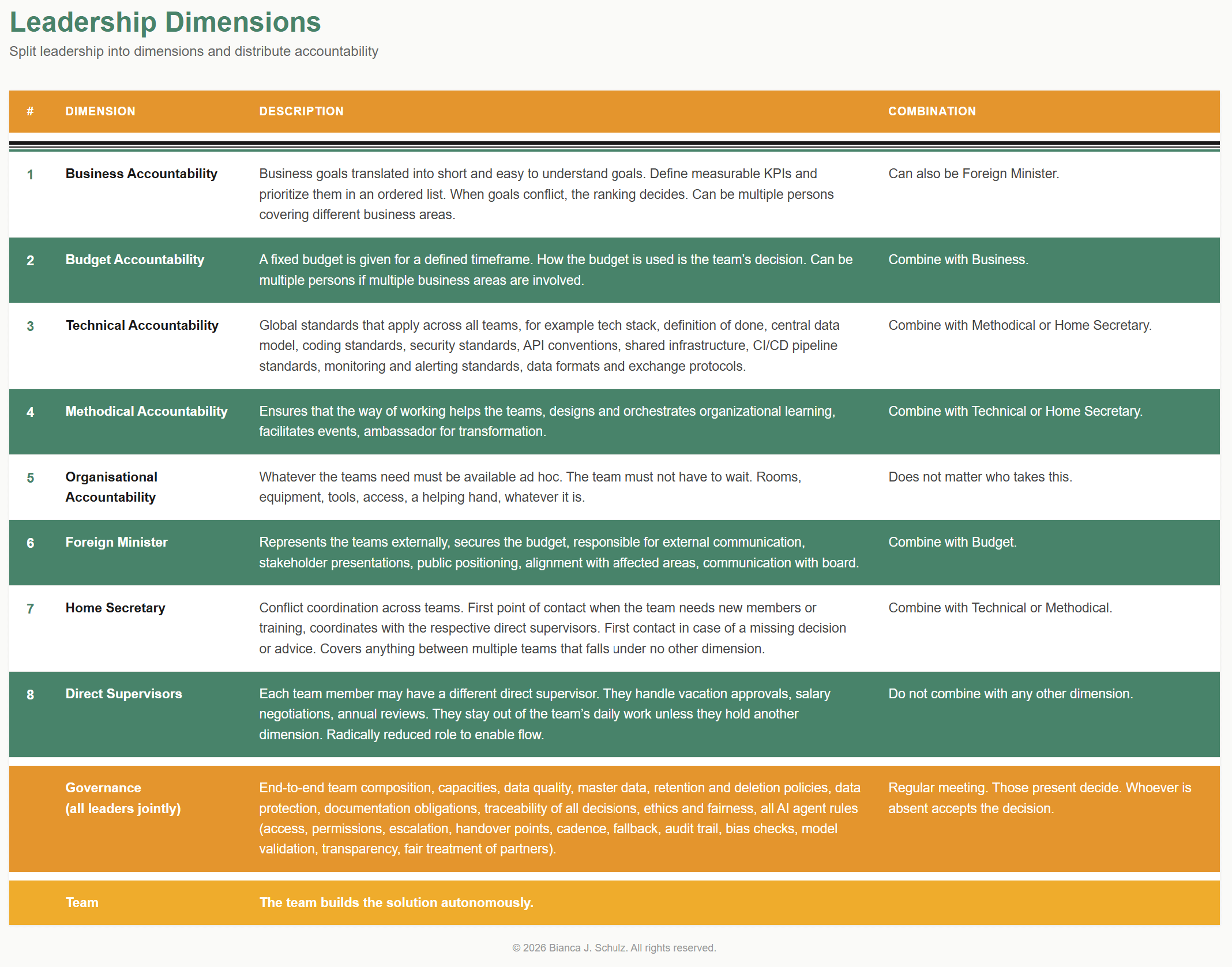
To prevent extremes, each person gets two or more dimensions.
The leadership team meets regularly to discuss the results of the team and to clarify governance questions. Whoever is not there carries the decision of those present.
Making strategy actionable
The leadership team has to do preparatory work before the team starts. The more thorough the preparation, the better the result of the teamwork. It has to be thoroughly thought through how the strategy can become actionable.
In my experience, the best way to execute a strategy is this: formulate goals that are short and punchy, that everyone understands, that are easy to remember, not too many of them, start with maximum five. Then create measurable KPIs for each goal.
Present it to the teams, listen to their feedback, refine if necessary.
Then give the team autonomy, everything it needs and tight boundaries.
Give the team recognition for performance and be consistent in keeping commitments, including killing initiatives when the results show it was the wrong path.
The teams will become high performers and your strategy will be executed without a problem. People love challenges for the same reasons they love competitive sports.
Setting tight boundaries
The expectations for the team are: Every Friday a sample of the new vegan chocolate must be ready for tasting. In the review, a test customer, the leadership team and the board taste the chocolate. The chocolate is evaluated against the defined KPIs. Likewise, the other KPIs regarding budget, sustainability, availability of ingredients, scalability to mass production etc. are evaluated.
Afterwards, learnings are discussed and a new plan for the coming week is set up.
The team has six weeks to come up with a recipe that truly meets the requirements. If that is not achieved, the topic gets killed and you start again with new ideas later, or not. This is how you protect budgets. This is how you make sure you do not burn millions. Set a budget for learning. Decide what budget you are willing to burn with learning as the only outcome. That is the time within which something must be production ready.
Be consistent. If it does not work, it is over. Everyone has to know that from the beginning. And then it has to be followed through.
Starting again later is allowed, but with different parameters. Learn from the failures.
If it works, production gets rolled out in line.
Boundaries: the budget for ingredients is tight and must not be exceeded. Even if the teams ask you to. Changing the boundaries may only happen when it truly makes no sense the way it was defined. For this the entire team has to talk with the entire leadership team. Together.
You see, the leadership team has to have a lot of time available quite often. But because the team has much more freedom than before, many leadership tasks fall away. Therefore the leadership team can also comfortably do nothing and simply be on call. There are many professions where that is normal. I consider this very important. You have to be immediately ready when you are needed. A fully booked calendar is no longer an option.
Not delivering a sample is unacceptable. The team must be clear on what is at stake. The review has to be embarrassing for them if they deliver nothing. Why? They could have said something earlier. You know a few days before that there is a problem. Then maybe something could have been salvaged. If that happened and the chocolate is still inedible, then in the review the mistakes are analyzed together.
Managers do not interfere in the teamwork. The team resolves conflicts among themselves. Real teamwork can only emerge when the team goes through highs and lows together. If something really bad happens, the team will speak up.
Rethinking incentives
How people tick. It is actually quite simple. You want meaningful work where you grow beyond yourself. You want recognition, you want to be seen, you want to be part of something bigger, you want to move forward and achieve more. For me it starts with an event, a review, but completely different from what you are used to.
Back to our example: At the reviews the board is present: you are seen! Performance is recognized. As soon as the chocolate goes into series production, there is a bonus.
Whenever possible make reviews hybrid. The people who can be there in person should feel it. Those who are dialed in remotely should be able to see the review well.
The leadership team that supports the team is also seen.
Keep the review SHORT! Taste chocolate, have it evaluated against the criteria, discuss problems. Briefly check budget compliance and other important governance topics. Done.
The reviews should be COOL. Everyone standing, except the board. It should be the opposite of a 30-person workshop with PowerPoint slides. Think beforehand with a few insiders about what cool even means in your organization. This is about an event. The room should fit, the way it is moderated, the way the team presents itself, all of this influences whether this establishes itself as a way of working, or not.
It should feel like you would miss something if you did not go.
Therefore no blah blah, no slides. Taste chocolate, evaluate, hard criticism, no sugarcoating, no softening.
When there is success to celebrate you can always throw a party afterwards.
The review is open to everyone, meaning interested people can be present as listeners or observers. This is important because it makes other departments want something like this too. I have experienced this many times. When the review gets really cool, when truly extremely awesome things are shown that no one in the organization EVER thought could be built in such a short time, then everyone else wants that too. That is the best engine for a transformation. Success! And being seen having success! And having fun doing it! And feeling like the best version of yourself! That is unbeatable.
To keep it cool, problems have to be discussed openly and hard. People who have been working in corporate for a long time sense within the shortest time whether something is fake or serious. If you want change, it has to be serious. The chocolate has to be finished. The product has to be in production or close to production. No discussion, no softening of standards. That would be the ultimate trust and motivation killer.
The leadership team also receives recognition from the board.
Making career then means: more responsibility and accountability in these dimensions INSTEAD OF team lead, department head etc.
Dissolving teams that do not perform must be transparent and priced in from the beginning.
I have seen organizations that actually go through with this. It is of course still frustrating for the team members. But I compare it to the FIFA World Cup (I am from Germany, here this is an important event). If you do not make it past the group stage, you are out. It is incredibly frustrating for the players when they are eliminated, strong men cry, BUT: it does not diminish the fascination of the game and it does not in any way reduce the appeal of participating. Quite the opposite.
Learning journey
Once you have managed with one team to roll out a good solution into production and increased the KPIs, you are ready to scale the new way of working to multiple teams. The leadership team also becomes more solid and begins to understand how the organization would need to change. The org chart becomes less and less important.
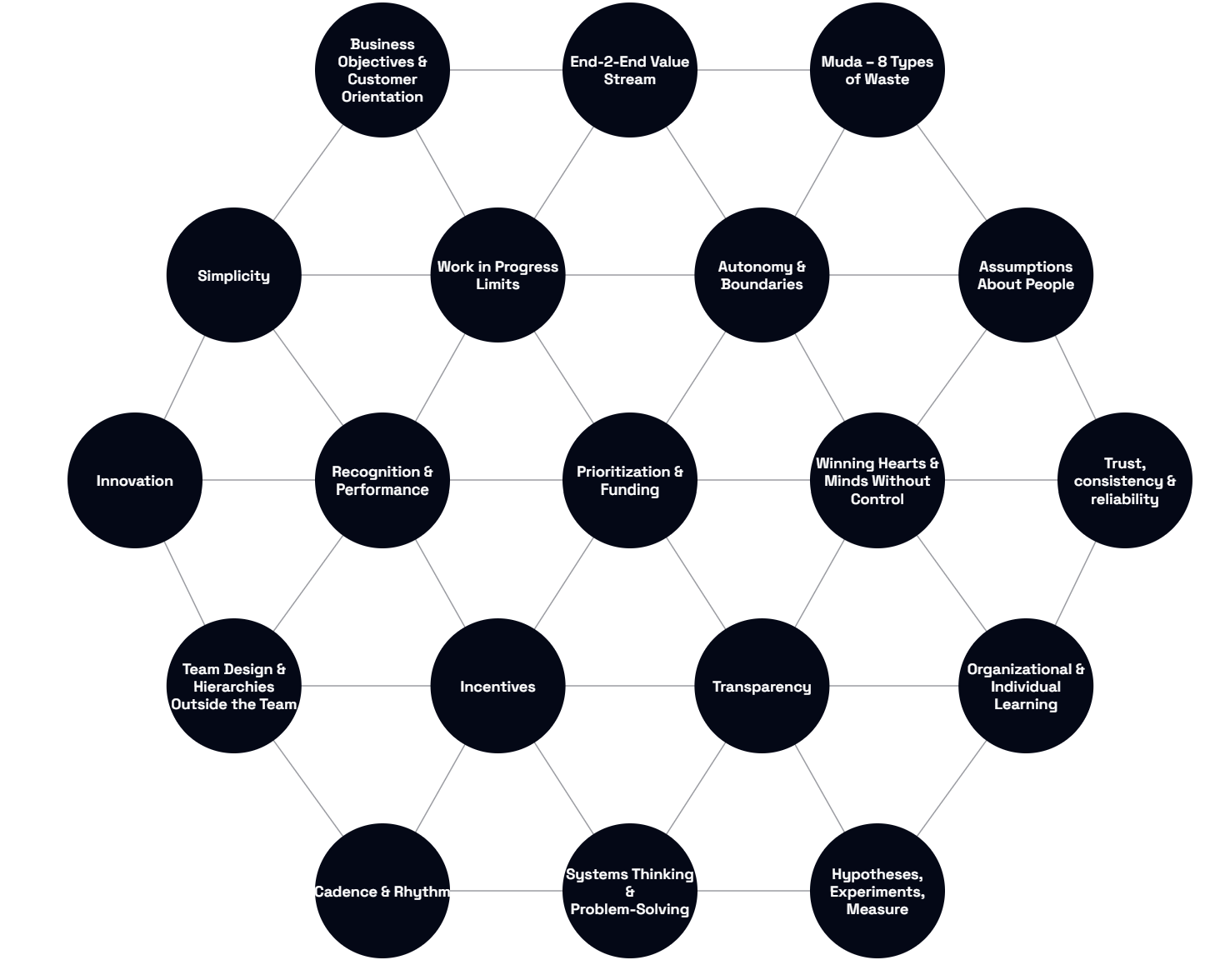
However: organizations learn slowly, it will be a long learning journey. In this article I have started to present some principles and possibilities. It is just the beginning and it is far from over. We still have to learn how to set up hypotheses, define experiments, measure and learn. We still have to learn how to orchestrate learning in the organization, how to establish a cadence, where work in progress limits are needed, how to reduce waste and much more. Many more articles will follow.
All articles will always be free, I will not do paid subscriptions. But I am very happy when you recommend the articles, especially to those who need exactly this kind of support. I work for organizations and use my Substack articles to present my work. Feel free to reach out, I would love to hear from you!
Hey Bianca!
That's beautiful exploration. I'd love to be on that Friday night chocolate tasting.
Who do you think is the “you”? Who did you write this for? Outside of a CEO, who do you think has the vision, the power, and the incentives to rewire today's very different organizations to look more like what you describe?